
Omkeshwar Singh, Head, Rank MF, a mutual fund investment platform, answers your queries.

In the Sensex kitty, ITC turned star performer by surging 2.45 per cent, followed by NTPC rising 2.19 per cent.

"What would be your advice for investors?" 'Keep it simple. Don't panic.'

Equity benchmark Sensex slumped 400 points on Wednesday tracking losses in index majors HDFC twins, Kotak Bank and TCS amid a weak trend in global markets.

Persistent capital inflows by domestic institutional investors and retail investors kept the markets in fine nick

The Sensex ended higher by 138 points at 19,367 and the 50-share Nifty advanced 43 points to close at 5,742.
Tata Motors was the top gainer among the Sensex stocks.

The NSE Nifty, comprising 50 shares, breached the 8,300-mark for the first time to hit a new lifetime high of 8,330.75.

Despite multiple headwinds at the start of 2023, the Indian markets delivered a strong performance, posting 19-20 per cent growth for the year. Even as new records were set, investor sentiment remains strong going into 2024, given the lower inflation, expectations of steady to lower interest rates, higher economic growth, and strong inflows. However, the overriding concern for most brokerages is valuations.

HDFC and Infosys contribute the most to today's rally.

Investors continue to make losses on investments.

Investor wealth slumped by Rs 3.7 lakh crore on Monday, as the equity market recorded its biggest single-day fall in two months.
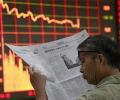
Mid- and small-cap funds dominate the list, opening up opportunity for investors to make contra bets in large-cap funds

The broader markets gained mid-caps and small-caps rising 0.3-0.4% on the BSE.

Omkeshwar Singh, head, Rank MF, a mutual fund investment platform, answers your queries

Mid- and small-cap indices have outperformed the frontline benchmarks - the S&P BSE Sensex (up around 10 per cent) and the Nifty50 (13 per cent) - in the first half of calendar year 2021 (H1-CY21) by rallying 26 per cent and 39 per cent, respectively. The trend, analysts believe, is likely to continue in H2-CY21 as well. The outperformance in H1-CY21 comes on the back of improved earnings and strong inflows from the foreign portfolio investors (FPIs) in Indian equities. However, good monsoon so far, gradual opening up of the economy and the pick-up in the pace of vaccination provides support to the market.

On the sectoral map, consumer durables stayed in the lead by surging 2.39 per cent, followed by realty index, oil and gas and infra.

Omkeshwar Singh, head, Rank MF, a mutual fund investment platform, answers your queries.

Construction major L&T was the biggest gainer among the Sensex components, spurting 2.30 per cent, after the company said its board has approved a Rs 9,000-crore share buyback plan.

'Historically, the lead-up to a general election tends to be excessively volatile and big losses are perfectly possible.'

Global funds have pumped in over Rs 38,000 crore (about $5.5 billion) into domestic equities since February 20, helping the Sensex rebound 2,671 points, or 7.6 per cent, from its 2019 low.

The Nifty closed at 4875, up 19 points. The market breadth was negative. Out of 2907 stocks traded on the BSE, there were 889 advancing stocks as against 1924 declines.

'12250 should be considered a reasonable level to re-enter into the market.'
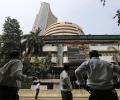
This was the biggest single-day fall for the benchmark index since August 10 when it had fallen by 310 points.

Omkeshwar Singh, head, Rank MF, a mutual fund investment platform, answers your queries.

PowerGrid was the top gainer in the Sensex pack, rising around 4 per cent, followed by NTPC, Tata Steel, Bharti Airtel, Sun Pharma and Bajaj Finserv. On the other hand, IndusInd Bank, Asian Paints, Infosys, Bajaj Auto and Maruti fell up to 2.59 per cent.

The broader market outperformed the benchmark indices as focus shifted to value buying in mid-cap and small-cap shares after the sharp gains on Friday. The Sensex was down 31 points at 17,399 and the Nifty closed flat at 5,278.

So which sectors are likely to do well in 2022? Should you focus on domestic economy-related sectors or export-oriented ones?

The Nifty shut shop below the 5300 mark at 5262, down 40 points. Not all was gloomy though. The mid-cap index ended marginally up at 6789 and the small-cap index addd nearly 1% at 8455.

The NSE Nifty closed at 4861, lower by eight points. The mid-cap and small-cap indices ended marginally lower.

The BSE mid-cap and small-cap indices were down 1% and 1.7% each. Market breadth was negative 2037 stocks which declined for 881 stocks which advanced.

The Nifty closed at 4,845, down 86 points. ONGC, ITC and HDFC Bank were the only gainers among the index stocks. And Gail and BPCL rose on hopes of deregulation in the prices of petroleum products.

Reflecting the bearish mood, all sectoral indices, led by metal, teck and healthcare, ended in the negative zone.

The market breadth was weak. Out of 2990 stocks traded on the BSE, there were 1080 advancing stocks as against 1848 declines.

'Sell in May, go away' is a popular market adage. But 'Don't sell any new shares in May' is the best kept secret of Dalal Street that's set to break. Sample this: the last four General Election election cycles starting 2004 have not seen a single initial public offering (IPO) launch during the month of May.

It's raining IPOs, with eight issues hitting the market in a span of six days. However, the pace of new filings points to a deluge during the latter part of the year. So far this year, 58 companies have filed their draft red herring prospectus (DRHP) with the market regulator for initial public offerings (IPOs), exceeding the combined tally of 50 in the last two years. Industry participants said the filing count could cross 100 this year, setting a new benchmark in terms of amount mobilised in a calendar year.


Omkeshwar Singh, head, Rank MF, a mutual fund investment platform, answers your queries.
